Skip to content
  • Home
  • About
  • Services
    • Services for Individuals
    • Services for Organizational Leadership & Change
    • Services for Schools and Families
  • The Empathy & Attunement Studio
  • Events
  • Blog
  • Contact
  • Quotes and Inspiration
  • Testimonials
  • Facebook
  • LinkedIn
  • Twitter
  • Instagram
  • Home
  • About
  • Services
  • The Empathy & Attunement Studio
  • Events
  • Blog
  • Contact
  • Quotes and Inspiration
  • Testimonials
  • Facebook
  • LinkedIn
  • Twitter
  • Instagram

Desiree Briel Rodi Consulting & Coaching

Business and People Strategy Unite

  • Home
  • About
  • Services
    • Services for Individuals
    • Services for Organizational Leadership & Change
    • Services for Schools and Families
  • The Empathy & Attunement Studio
  • Events
  • Blog
  • Contact
  • Quotes and Inspiration
  • Testimonials
  • featured
  • Three Thoughts for Thursday
  • Uncategorized

Three Thoughts for Thursday – May 2021

Desiree Briel Rodi Consulting & Coaching's avatar Desiree Briel Rodi Consulting & Coaching May 20, 2021

            On my wedding day, we had planned to say our vows outdoors in the autumn beauty of Southwestern Colorado.  I’d grown up there and the fall was always my favorite time of year with warm, sunny days and beautiful aspens turning gold among the evergreens.  We woke up to rain, not just a drizzle, but torrential downpour, complete with thunder and lightning. No problem, we had a backup plan to move the ceremony indoors.  Then the power went out so we hunted up every candle we could find. No problem, surely the power would be restored by dinnertime. We took photos, dashing out from the covered patio when the rain would take a break to capture the shot.  The overcast skies made the colors pop!  The power did not come back on in time for dinner.  No problem, the stoves were gas stoves and a few friends had brought their guitars – dinner by candlelight and music played by friends, what a gift! 

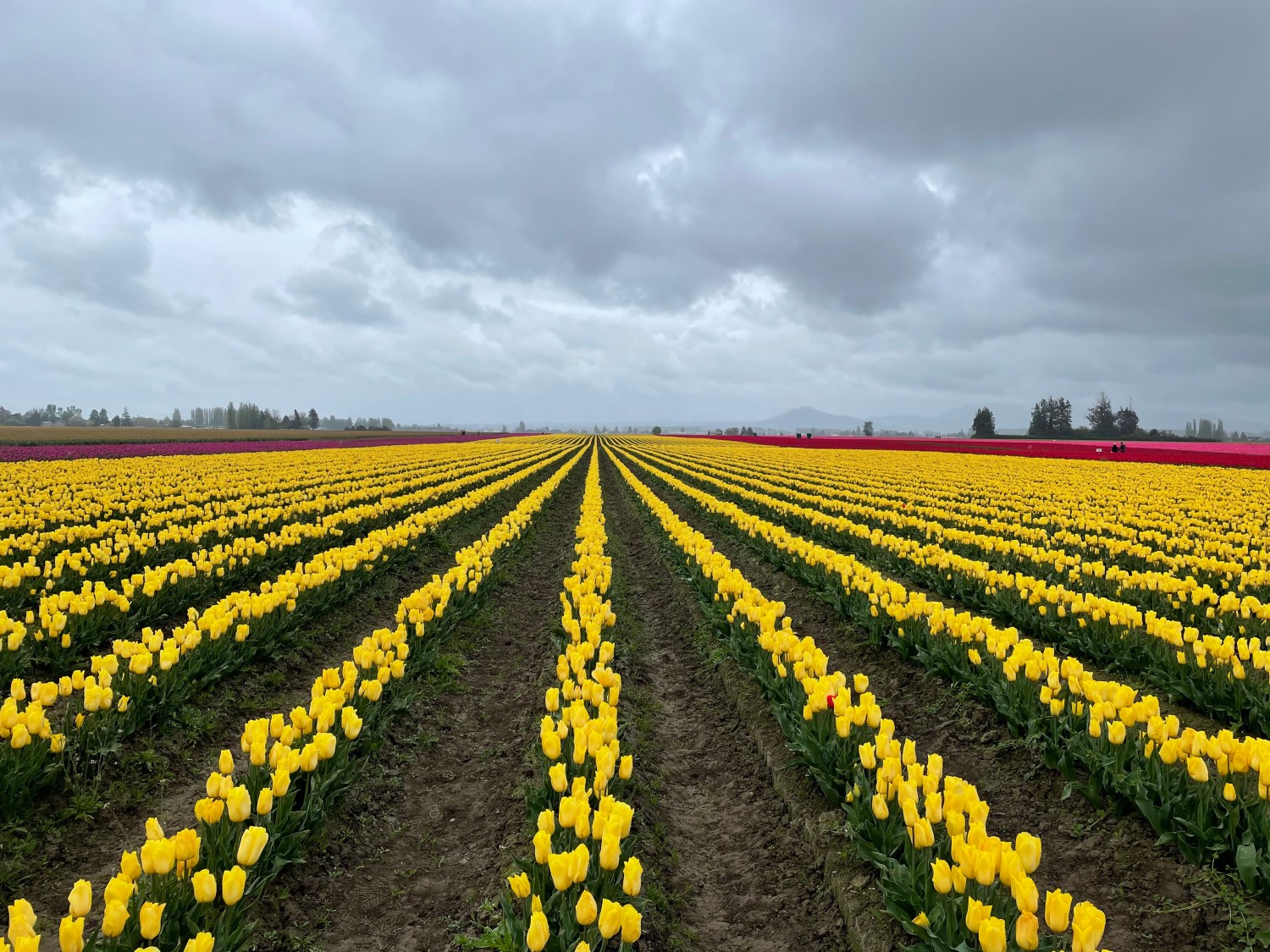
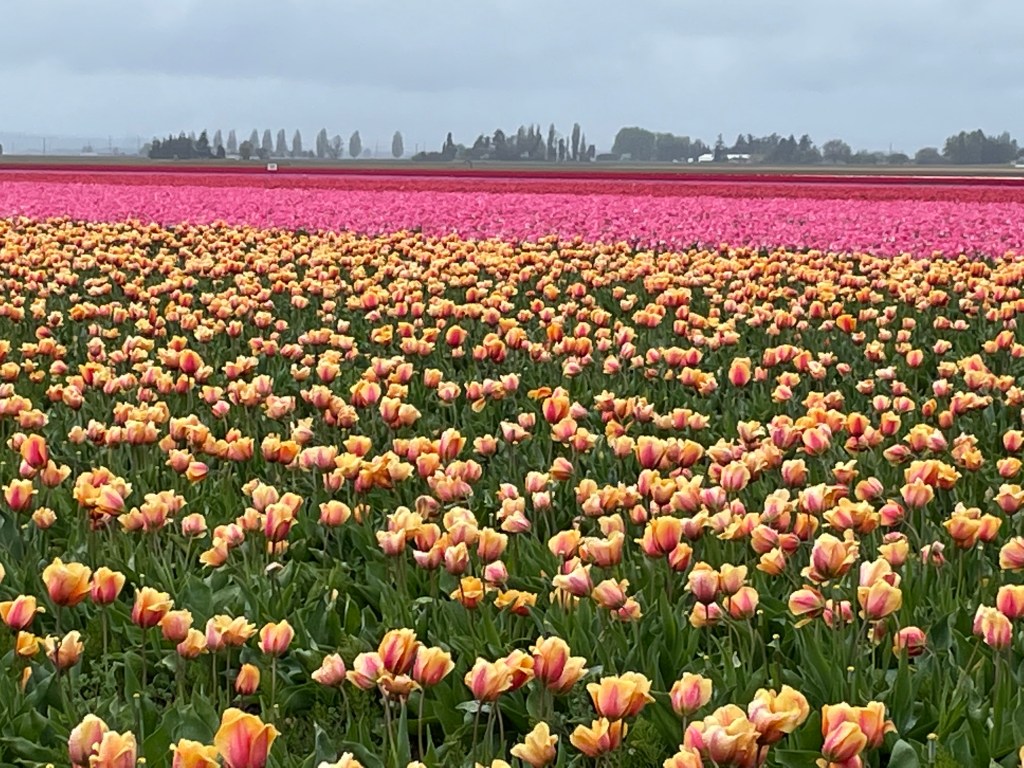
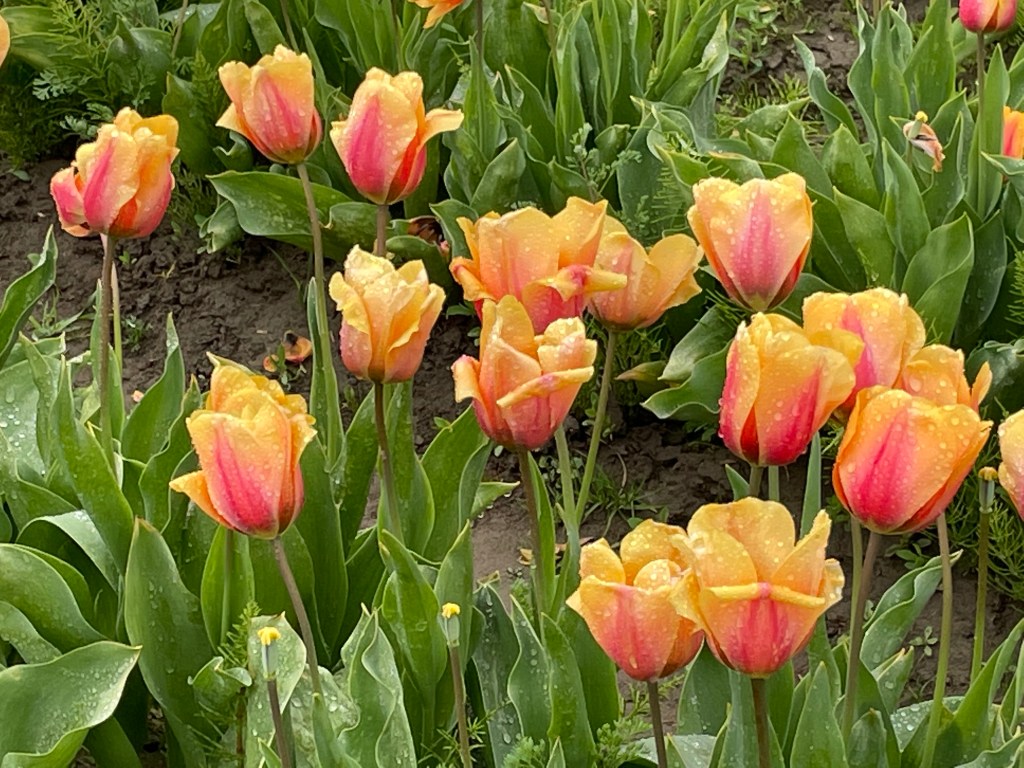
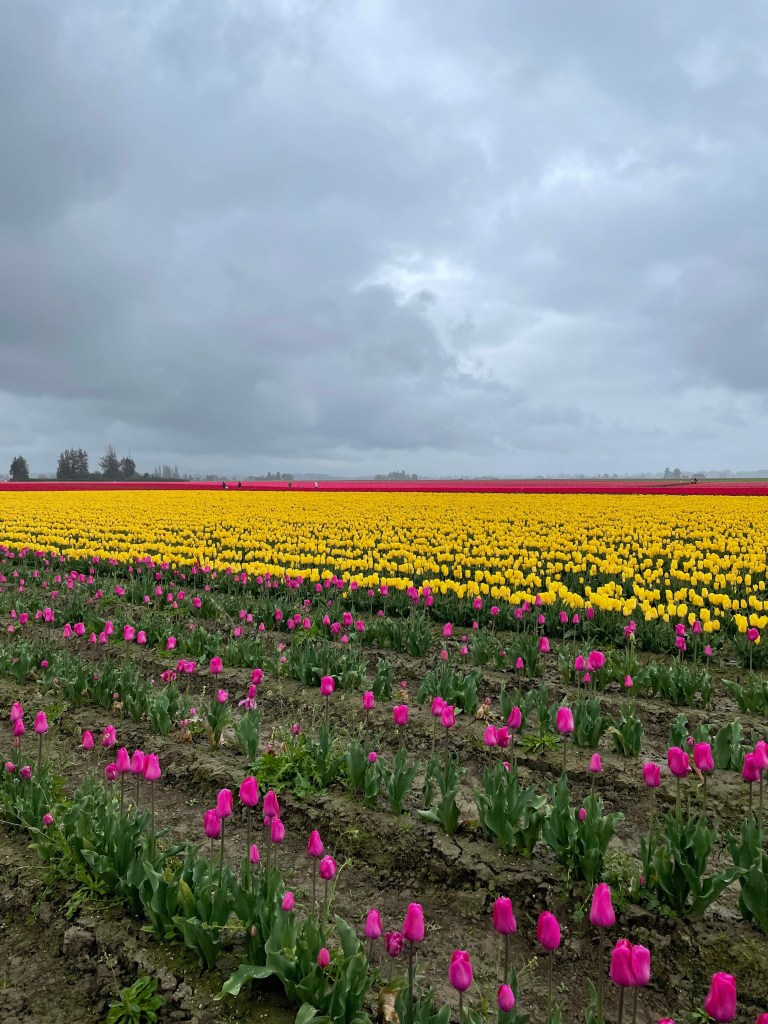
            This year, we made it to the Tulip Festival in Skagit Valley just north of where we live.  It was a bit rainy as we set out.  No problem, there were no crowds to navigate, and wow did the colors pop!  As we stood in the colorful fields of tulips and daffodils, storm clouds overhead, a light drizzle around us, I couldn’t help but think of my wedding day, and in a broader sense, of how the storms of life can make joy really stand out.  I also couldn’t help but see the joy of my boys as they bought me a bouquet of flowers.  The clouds and drizzle couldn’t dampen the beauty they saw. As I looked through their eyes, I, too, felt joy in the beauty I saw before me in the meeting of the storm clouds and the fields of blooming tulips as far as the eye could see. The beauty of the bloom was dependent on the rain from these clouds.

The contrast of the dark and threatening skies and the fearless beauty of the flower seems important, essential even.  The focus of our vision determines what we see and what we make of the situation, of the picture before us. Do you typically see the storm clouds and fear the rain? Do raindrops make you want to go inside and wait for sunny weather? Do you see how the overcast skies serve to make the colors even brighter in contrast? Do you focus on the clouds or the flowers? What about in your life?  Do you focus on the fear, uncertainty, and suffering or do you savor and appreciate the contrasting joy and beauty? Do the dark days make the good days even more valuable and precious?  Where does your focus lie? How can you begin to reframe the storm clouds that may allow your view to change and the colors, the joy in your life, to “pop”?
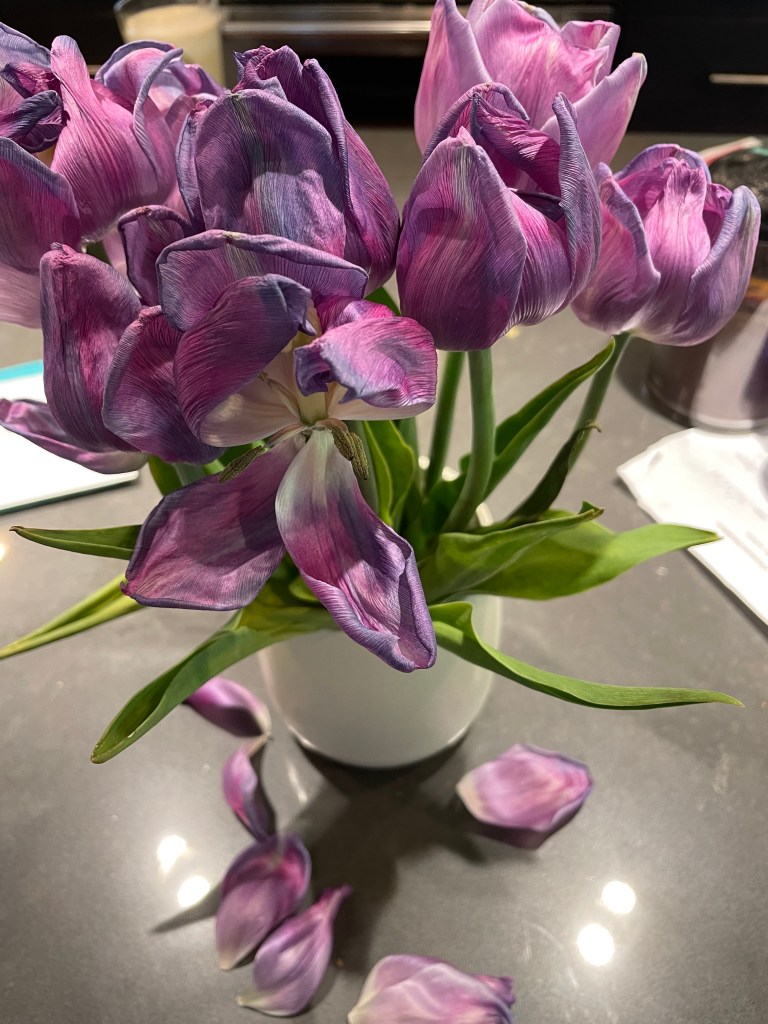
Do you see wilting flowers or the beauty of the bouquet my boys bought for me a week past its harvest?

Quote(s) I am sitting with, pondering, and find inspiring:

Don’t let the fact that you don’t know what you’re doing stop you from doing anything.

We start everything from a place of not knowing – walking, reading, dating, working. And through the doing, we learn.

We may not get it right the first time, but eventually, we know what we’re doing.

~ Neil Strauss, @neilstrass ~
Podcast I’m Listening to:

Quit Overthinking Things – HBR IdeaCast

Ethan Kross, Professor of Psychology at the University of Michigan, has spent years studying how people talk to themselves and the effect that this “chatter” has on our performance. From professional athletes to top students and senior business executives, even the most talented among us sometimes struggle to quiet the voices in our heads. And Kross says that, while some self-talk can help us, it’s often unproductive. He offers tips and tricks to break out of negative thinking and get back on track, especially at work.  He is the author of the book, Chatter: The Voice in Our Head, Why it Matters, and How to Harness It.

My notes:

I appreciated this podcast as I thought about the clouds and the flowers, and how our perspectives and lenses can become habits. Kross highlights negative thought loops, the inner voice, struggling with chatter, frequency, and intensity which can vary, and calls out the impacts of this chatter specifically on these areas of life:

  1. Thinking and performing at work
  2. Social Relationships
  3. Physical Health

Uncertainty propels chatter, and we can get stuck – this seems especially relevant in the uncertainty in which we’ve been living. I often refer to getting stuck as “the hamster wheel.” Kross also notes that chatter factors into depression and anxiety.  We have a lot of time alone with our thoughts.

Tips from Kross to tame the chatter:

  • Distant self-talk – giving advice to yourself that you’d give to someone else. Leverages language to switch our perspective and how we relate to ourselves.
  • Self-coaching
  • Temporal distancing or mental time travel – how will I feel 6 months from now? Broadens perspective and gives hope
  • Use environment to calm chatter – create focus
Book I am Reading:

I have been working to question and get curious about my own lens and habits, and on understanding and taking control of changing habits, such as I mentioned above for instance, the voice in my head that often allows negative self-talk to take the stage first.  As a part of this curiosity, I have been trying to cultivate a gratitude practice and space for a more positive, optimistic self-talk.  Working to cultivate new ways of being and new patterns has set me on a path to understand habits, and how I might break old habits and ways of seeing that may lead me astray or cause me to stumble.  Likewise, I want to understanding how I might replace these old habits with new habits that better serve me on my path.

The Power of Habit: Why We Do What We Do in Life and BusinessNEW YORK TIMES BESTSELLER • This instant classic explores how we can change our lives by changing our habits.

NAMED ONE OF THE BEST BOOKS OF THE YEAR BY The Wall Street Journal • Financial Times

In The Power of Habit, award-winning business reporterCharles Duhigg takes us to the thrilling edge of scientific discoveries that explain why habits exist and how they can be changed. Distilling vast amounts of information into engrossing narratives that take us from the boardrooms of Procter & Gamble to the sidelines of the NFL to the front lines of the civil rights movement, Duhigg presents a whole new understanding of human nature and its potential. At its core, The Power of Habit contains an exhilarating argument: The key to exercising regularly, losing weight, being more productive, and achieving success is understanding how habits work. As Duhigg shows, by harnessing this new science, we can transform our businesses, our communities, and our lives.

With a new Afterword by the author

“Sharp, provocative, and useful.”—Jim Collins

“Few [books] become essential manuals for business and living. The Power of Habit is an exception. Charles Duhigg not only explains how habits are formed but how to kick bad ones and hang on to the good.”—Financial Times

“A flat-out great read.”—David Allen, bestselling author of Getting Things Done: The Art of Stress-Free Productivity
 
“You’ll never look at yourself, your organization, or your world quite the same way.”—Daniel H. Pink, bestselling author of Drive and A Whole New Mind
 
“Entertaining . . . enjoyable . . . fascinating . . . a serious look at the science of habit formation and change.”—The New York Times Book Review
Please check out my latest blog post, Are we Losing Our Humanity?  You can also find recent posts Lessons from the Run, Part 1: Mile 18 – Endurance, and Lessons from the Run, Part 2: Resilience, Lessons of the Run, Part 3: Rest, andBe and See the Light which are all still relevant to our current circumstances. If you missed my April edition of Three Thoughts for Thursday, you can find it here, on my blog as well. On April 27th, Kathy Hadizadeh and I kicked off the Emotional Intelligence Special Interest Group for ICFLA.  Our next session will take place on Tuesday, June 22nd at 11 am PST and will focus on Self-Awareness. If you are interested in joining and co-creating this learning community, please use the link above to find out more and to come along for the journey!

I’m always looking for new inspiration, new books to read, new podcasts to listen to, so please send your suggestions my way or comment on this post to offer some new recommendations!

As always, thank you for your continued support and readership! Stay strong, stay brave, stay true to you!

  • featured
  • Three Thoughts for Thursday
  • Uncategorized

Three Thoughts for Thursday – April Showers 2021

Desiree Briel Rodi Consulting & Coaching's avatar Desiree Briel Rodi Consulting & Coaching April 15, 2021

April showers provide hydration for growth. What is nourishing you these days?

Read More "Three Thoughts for Thursday – April Showers 2021"

  • featured
  • Three Thoughts for Thursday
  • Uncategorized

Three Thoughts for Thursday – March 2021

Desiree Briel Rodi Consulting & Coaching's avatar Desiree Briel Rodi Consulting & Coaching March 18, 2021
Photo by Arno Smit on Unsplash

Spring has come again!  The seasons and passing of time have remained consistent even in a year fraught with inconsistency and turmoil.  I so clearly remember last spring and the hope I gathered from the cherry blossoms, sunshine, and planting a garden with my boys even as COVID began to shut down life was we’d known it.  Little did we know, the seasons would come and go, and we’d see a whole year impacted by the virus. Last March, I thought about the mess and reflected on the learnings from watching my kids plant seeds with reckless abandon and celebration if one seed came to fruition.  This March, I am thinking about compost and its importance in growing new things. Compost is made up of waste, things discarded, that break down and enrich the soil for new life to spring forth.  Different waste composts at different rates.  I don’t know about you, but I have a lot of compost from this past year!

As I reflect on this last year and the learnings, many are already obvious and some are even ready to bloom.  Other things are still in process and will take time, possibly another year or longer, to breakdown into life-giving goodness, new ideas, new nourishment, new blooms. I am pondering the patience and resilience of the seed and how a seed germinates in its own time.  Spring always gives me the itch to plant, to dig in the dirt.  Perhaps it is from my ancestors who were farmers and there is something genetic that springs forth with the coming of warmer weather and longer days.  Regardless of where it comes from, the desire comes every year.  This March, I am assessing the past year and taking the rich compost to offer the seeds I want to plant. I am also turning over the soil and compost of the hardships that may still need more time to break down. As I reflect upon and observe those things still needing time to decompose and offer their wisdom, I am striving to be patient, yet persistent. I can begin to see the beauty in the process and the lessons in this cycle of composting, planting, and feeding the soil to ensure growth.

I am reminded to lean in, to wait and endure with grace – not all things break down at once to offer their nutrients and support growth.  There is beauty in the consistency of this eternal and ongoing process.  I am also reminded that some of the best lessons in life spring forth with time. I am appreciating and seeking the lessons of nature with the coming of spring.  

What is already blooming this spring for you?  What have you learned this past year that is inspiring you?  What still needs more time to break down in order to offer lessons, insights and the nutrients for growing something new?  What do you observe from this process of personal composting? What is giving you hope these days, and reminding you to patiently wait?


  • Photo by Johannes Plenio on Unsplash


  • Photo by Aaron Burden on Unsplash


  • Photo by Biegun Wschodni on Unsplash

Quote(s) I am sitting with, pondering and find inspiring:

“Do the best you can until you know better.  Then when you know better, do better.”

~ Maya Angelou ~

Photo by Yoksel 🌿 Zok on Unsplash

Passage I’m Reading and Re-Reading:

A Garden of Poems

One Day in New York City, I met a Buddhist scholar and I told her about my practice of mindfulness in the vegetable garden.  I enjoy growing lettuce, tomatoes, and other vegetables, and I like to spend time gardening every day.

            She said, “You shouldn’t spend your time growing vegetables.  You should spend more time writing poems.  Your poems are so beautiful. Everyone can grow lettuce, but not everyone can write poems like you do.”

            I told her, “If I don’t grow lettuce, I can’t write poems.”

~ Thich Nhat Hanh ~

Your True Home: The Everyday Wisdom of Thich Nhat Hanh, #103

Photo by Kenan Kitchen on Unsplash

Book I am Reading:

How To Be More Tree: Essential Life Lessons for Perennial Happiness by Liz Marvin, Illustrated by Annie Davidson

What Amazon has to say:

A beautifully illustrated celebration of the wisdom of trees and what they can teach us about everyday life, from basking in the sun to weathering the storm.

This sweet and informative book brings together fifty-nine universal life lessons taken from the infinite wisdom of trees. As you learn about dozens of trees, from the Acai palm to the Yoshino cherry, you’ll find that their means of survival are not so different from ours. The juniper tree proves that it’s possible to flourish anywhere as long as we put down strong roots. A mountain hemlock finds strength basking in the sun while a black walnut’s sturdiness comes from its thick, steely core. The hawthorn demonstrates resilience as it adapts to strong winds and storms by finding balance in its roots.

Trees have many more lessons to offer, from letting go of the past, to branching out, to resisting the urge to overstretch ourselves. With detailed illustrations and advice for lifelong happiness, How to Be More Tree is an essential companion for all those moments when we’re having trouble seeing the forest for the trees.

Photo by bantersnaps on Unsplash

Please check out my latest blog post, Are we Losing Our Humanity?  You can also find recent posts Lessons from the Run, Part 1: Mile 18 – Endurance, and Lessons from the Run, Part 2: Resilience, Lessons of the Run, Part 3: Rest, and Be and See the Light which are all still relevant to our current circumstances. Stay tuned for my upcoming blog posts My Vision: The Power of EQ to Create Change, and my thoughts on Courage vs. Confidence!  If you missed my February edition of Three Thoughts for Thursday, you can find it here, on my blog as well.

I’m always looking for new inspiration, new books to read, new podcasts to listen to, so please send your suggestions my way or comment on this post to offer some new recommendations!

As always, thank you for your continued support and readership! Stay strong, stay brave, stay true to you!

Photo by Alexandru Tudorache on Unsplash

  • featured
  • Uncategorized

Are We Losing Our Humanity?

Desiree Briel Rodi Consulting & Coaching's avatar Desiree Briel Rodi Consulting & Coaching March 18, 2021

Or is this an Opportunity to Regain our Humanness?

            Almost twenty years ago, when the Twin Towers were taken down by commercial airplanes commandeered by terrorists, there was a common enemy quickly identified that united us as a nation. We were brought together by a common drive to ensure “Never Again”, never again will we allow an attack to happen on U.S. soil.  We did not walk away unscathed, however.  As Brené Brown found in her research and has given voice to, we moved forward, but we were changed; we became a generation of fear, a generation driven by scarcity.  Our naivete had been lost.

            As someone who is an extrovert, I have suffered from the isolation forced upon us by COVID.  I have noticed recently how people avert their eyes (all we now see of each other’s masked faces) as they walk by and don’t even make eye contact.  In this time, as we mark 1 year since COVID began to change our world and became a global pandemic, I find myself questioning whether or not we are losing our humanity.  There is no common enemy to unite us in this battle with a virus, an invisible adversary.  Rather, we are divided and isolated in our fight to stop the spread of this detrimental virus.  We are laden with fear, the air is thick with it, even if we don’t feel fear ourselves at an individual level.  This is not just a national dilemma, but rather one that has had global implications.

I have seen friendly neighbors avoid us “like the plague.”  I have seen judgments passed and hurtful comments spat about for either wearing a mask or not wearing a mask. Division, resentment, frustration have grown in the space of our isolation.  I have seen people walk out of the way to avoid me and others.  It is as if we are each a potential and deadly weapon in the spread of this unseen disease.  We can’t even, won’t even, look at each other.  I suppose in many ways, we are indeed each a potential carrier of illness and harm. And yet in our isolation and in our humanity, we are each longing to be seen, understood, heard, at least I know I am.

            I have observed lately, people on the brink, on the edge, if you will.  Not only do I feel the fear of this virus and the weariness as the isolation goes on, I have felt the anxiety of unexpected responses.  A common “Hello! How are you?” may unleash relief and joy at being acknowledged, or may unleash judgment, or even rage and anger built up over the months and months of loneliness, stress, and fear.   I have found I rarely know what I will get back if I make eye contact or dare to say hello. 

Likewise, I have seen and sensed and heard the fear when people dare to acknowledge and see me.  They are also likely wondering if I am on the edge and which way I will fall if somehow provoked.  I was recently at the gym for a swim – cue the judgment and my need to justify how I was being safe – and had also given birth 7 weeks prior.  This was my maiden post-partum swim, so to speak.  I had diligently made appointments to swim three to four times a week during my pregnancy, from the time when our gym’s pool reopened by appointment until two days before my daughter was born.  Yes, I had a pregnancy and a baby during COVID – that is another topic for exploration. 

The same lifeguard had been on duty, also a mother, and had always waved from the other end of the pool to acknowledge my presence.  Now and then, she even shouted a word of encouragement and had dared to ask when I was due.  Upon my return to the pool, she briskly walked over in her mask, maintaining some distance, and said “I was so excited to see your name on the schedule!  How are you?  How is your baby? Did you have a girl or a boy?  Can I see a picture?”  Then “Gosh, is that okay?  I’m so sorry, I hope this is okay.”  Her fear of judgment nearly consumed her joy and I wanted to hug her to reassure her not only was it okay for her to ask about me and my baby, and to ask to see a picture, it was the greatest gift I’d received in months!  I was so grateful to be seen and acknowledged, to be asked after, I felt tears spring up in my eyes!

Last week, I ventured out to the mall which was desolate.  I entered a store and was so grateful the woman working was friendly and asked about my baby in tow.  We chatted and discussed the current COVID-environment.  She mentioned she had been afraid I would be put off by her friendliness.  Just the week before, a woman had been in and when the saleswoman had leaned in and asked her to speak up so that she could help, the customer went fleeing and called corporate to report the “inappropriate behavior.”  The kind saleswoman said it was the first time in 15 years of working retail, a complaint had been filed against her with corporate, a complaint for simply trying to be helpful.

I am concerned by the levels of tension and fear that may or may not be obvious at first glance, bubbling beneath the surface. I worry about all the people hanging on by a thread. These days, I often worry we are losing our ability to connect as human beings in this mess, as if this virus is the final straw that will break us, not of our need for social connection, but of our ability to fulfill this social need.  What I see is a desperate human need for connection and the longer we go without, the less empathy we have, the less ability we have to meet our needs for connection.  This makes me think of going without food and water for too long. Either you lose your appetite, or you gorge yourself only to vomit it all up.  People are starving and many can only see their own needs. We’ve been without connection for so long now; we no longer even know how to respond when it is offered, or we’re so hungry for it, we’re senselessly clawing and clamoring to get our own needs met we fail to see the needs of others. 

Of course, some may say people are showing kindness and empathy when they walk to the other side of the street as me and my kids and baby pass by.  Perhaps they aren’t thinking of me and my brood as possible infectors but rather are going out of their way to keep us safe.  Perhaps. Some may also say empathy and connection are happening more in the workplace as work has been fully integrated with the home, and the kids popping in, once an exception, is now more normal. Perhaps.  We are indeed finding new ways to try to connect and I have been encouraged by the creativity people have exhibited in finding ways to gather online. While online gatherings and phone calls certainly help, do they really fulfill us in a sustainable way? As we slowly begin to interact with others again, I can’t help but observe, perhaps we will all need to be re-socialized.  The social skills we learned as children we will need to learn again.  Perhaps it was time for a tune-up in our social abilities anyway.  I certainly hope we can come back kinder, more accepting, and more empathetic.

What do you think?  How are your levels of empathy holding up? Are your needs for social connection being met or are you hungry for connection? How are you doing, really?  How are you feeling, truly? What is your degree of internal fear?  What is your level of tolerance for the external environment of fear? Is our collective fear bringing us together or driving us apart? Are we losing our ability to socialize and fulfill this human need for connection?  Have we been starved of human connection too long? Are we losing our empathy and our ability to see, truly see, one another and have patience and grace with each other?

  • featured
  • Three Thoughts for Thursday
  • Uncategorized

Three Thoughts for Thursday – Creativity & Love – February 2021

Desiree Briel Rodi Consulting & Coaching's avatar Desiree Briel Rodi Consulting & Coaching February 18, 2021

I lost a dear friend to a stroke last week.  Rod Graham first came to our home to paint our downstairs family room and a room upstairs that would become the nursery for our second child.  He spent quite a lot of time in our home – he was not fast, but honest and meticulous.  My son, not yet 2 years old at the time, nicknamed him “Mr. Paint” and it stuck.  Over the years, he painted the office of a friend, the condo of my in-laws, and eventually when we returned to our home after two years in Los Angeles, he painted every room in our house himself so as to get us settled back in as soon as possible.  He lovingly refinished our deck, complete with a furniture finish, bringing life back to the wood we weren’t sure we could save, and making this outdoor space as inviting as the indoors. I was looking forward to him being around this summer to paint the exterior of our home.  His Christmas card had reassured me he would hire a crew and certainly wouldn’t attempt to paint the whole exterior of the house himself. He’d spent nearly 9 months painting the interior – have I mentioned he was meticulous? I also learned to appreciate that Mr. Paint didn’t let work consume him; he made time for people and activities that brought him joy.  I remember on more than one occasion, he wrapped up for the day around 3 or 4 pm and changed to go listen to live music and enjoy a glass of wine. He was always reading something new and interesting, and never hesitated to take time to have a conversation.

Mr. Paint was far more than a house painter, he was a cherished friend and inspiration. At 71 years young, he was a curious, wise, and kind man. We not only discussed paint colors, but books, philosophy, and life.  He had taken an interesting and winding path. Having studied marketing and accounting at UW before finding his way into painting, his journey was unique and I appreciated the opportunity to hear his story and his learnings, his musings and humorous contemplations.  He didn’t seem to take life too seriously and seemed adept at rolling with the punches. I am grateful to have witnessed his reflections, experienced his kindness and joy, his love of books, and his friendship and support.  He always took the time to comment on my latest Three Thoughts email or blog post, to share a quote, to text me a message of hello and a note for my boys.  He was humble, honest, and unassuming, and I am so grateful to have known him.  I dedicate this month’s Three Thoughts for Thursday to Rod Graham, our dear Mr. Paint. May you rest in peace and may we all take more time to laugh and learn, to explore with genuine curiosity, and to appreciate the beauty, creativity, and depth within ourselves, and within one another.

~

As I thought about this month’s post, and about my friend, Rod Graham, I thought a great deal about our unique abilities, talents, and creativity as human beings, often not apparent at first glance.  Whether it is baking or painting, drawing or writing code, landscaping or poetry, knitting or building an engine, photography, making a snow angel or building a snowman, we each have an inherent need to create. We have unique and imaginative gifts and outlets, ways of filling ourselves with positive energy and sharing this positivity with others.  This month, I encourage you to reflect upon and ponder your own creativity. What are your talents and abilities?  What do you enjoy creating?  How does creating, innovating and using your talents make you feel? How might you allow yourself more time and space to expand your ingenuity and to harness this energy?  How might you inspire others to lean into their talents and abilities, and to make space to create?  What if you took more time to get to know yourself and others, and the hidden creativeness within? How might creativity be the key to resourcefulness and making other aspects of your life better?

Photo by RhondaK Native Florida Folk Artist on Unsplash

Quote(s) I am sitting with, pondering and find inspiring:

“We build up cognitive reserves that way [doing things we love], which will help us when emotional turmoil inevitably strikes.”

~ Marc Brackett, Permission to Feel (162) ~

“Art washes away from the soul the dust of everyday life.”

~ Pablo Picasso ~

“You were born an original.  Don’t die a copy.”

~ John Mason ~

Podcast I’m Listening to:

Oprah’s Super Soul Conversations – FULFILLMENT

Making the shift from self to service brings joy and also a deep sense of fulfillment to our jobs, relationships and the vision we create of our best life, says Oprah’s friend Gary Zukav. He says this is the moment when we discover authentic power – “when your personality comes fully to serve the energy of its soul.” Fulfilling your purpose, with meaning, is what gives you that powerful spark of energy unique only to you, he says.  In this episode of Super Soul Conversations, Oprah sits down with such inspirational teachers, including Gary Zukav, Mastin Kipp, Paulo Coehlo, Sue Monk Kidd, Pastor Wintley Phipps, Nate Berkus, Diana Nyad, India Arie, Janet Mock, Jack Canfield, Daniel Pink, Daniel Goleman, Shawn Achor, Jeff Weiner, Wes Moore, Shonda Rhimes and Devon Franklin, to reveal how we can tap that source, which is our highest and truest version of ourselves. Interviews with these talented writers, speakers and thought leaders are excerpted from Oprah’s Emmy Award-winning show Super Soul Sunday.  You can also find this compilation and other insightful conversations in Oprah’s best-selling book The Wisdom of Sundays.

Photo by Riccardo Annandale on Unsplash

Book I am Reading:

Homegoing by Yaa Gyasi

This month, rather than a self-development book, I am sharing a book I am listening to on Audible, not for work but for my personal enjoyment and expansion.  Recommended by a friend, I was looking to experience a new author, a new story, and to expand my repertoire. I have been listening to this book to challenge my listening skills and have loved being able to listen to the story as I run, as I drive, as I sit quietly, or as I make dinner – there is always time to listen.

Winner of the NBCC’s John Leonard First Book Prize, a New York Times 2016 Notable Book, one of Oprah’s 10 Favorite Books of 2016, NPR’s Debut Novel of the Year, one of Buzzfeed’s Best Fiction Books of 2016, One of Time’s Top 10 Novels of 2016, Ta-Nehisi Coates notes “Homegoing is an inspiration.”  The unforgettable New York Times best seller begins with the story of two half-sisters, separated by forces beyond their control: one sold into slavery, the other married to a British slaver. Written with tremendous sweep and power, Homegoing traces the generations of family who follow, as their destinies lead them through two continents and 300 years of history, each life indelibly drawn, as the legacy of slavery is fully revealed in light of the present day.

Effia and Esi are born into different villages in 18th-century Ghana.  Effia is married off to an Englishman and lives in comfort in the palatial rooms of Cape Coast Castle. Unbeknownst to Effia, her sister, Esi, is imprisoned beneath her in the castle’s dungeons, sold with thousands of others into the Gold Coast’s booming slave trade, and shipped off to America, where her children and grandchildren will be raised in slavery. One thread of Homegoing follows Effia’s descendants through centuries of warfare in Ghana, as the Fante and Asante nations wrestle with the slave trade and British colonization. The other thread follows Esi and her children into America. From the plantations of the South to the Civil War and the Great Migration, from the coal mines of Pratt City, Alabama, to the jazz clubs and dope houses of 20th-century Harlem, right up through the present day, f makes history visceral and captures, with singular and stunning immediacy, how the memory of captivity came to be inscribed on the soul of a nation.

Please check out my blog posts on Lessons from the Run, Part 1: Mile 18 – Endurance, and Lessons from the Run, Part 2: Resilience, and Lessons of the Run, Part 3: Rest, as well as my blog post on the light at the end of the tunnel – Be and See the Light! Stay tuned for my upcoming blog posts, Are We Losing Our Humanity?,  My Vision: The Power of EQ to Create Change, and my thoughts on Courage vs. Confidence!  If you missed my January edition of Three Thoughts for Thursday, you can find it here, on my blog as well. As always, thank you for your continued support and readership! Stay strong, stay brave, stay true to you!

Posts pagination

Previous 1 … 15 16 17 … 24 Next
Blog at WordPress.com.
Desiree Briel Rodi Consulting & Coaching
Blog at WordPress.com.
  • Subscribe Subscribed
    Desiree Briel Rodi Consulting & Coaching
    Join 36 other subscribers

    Have a WordPress.com account? Log in now.

  • Desiree Briel Rodi Consulting & Coaching
    View site in Reader
    Manage subscriptionsSign upLog in
    Report this content
    Collapse this bar
Loading Comments...