Skip to content
  • Home
  • About
  • Services
    • Services for Individuals
    • Services for Organizational Leadership & Change
    • Services for Schools and Families
  • The Empathy & Attunement Studio
  • Events
  • Blog
  • Contact
  • Quotes and Inspiration
  • Testimonials
  • Facebook
  • LinkedIn
  • Twitter
  • Instagram
  • Home
  • About
  • Services
  • The Empathy & Attunement Studio
  • Events
  • Blog
  • Contact
  • Quotes and Inspiration
  • Testimonials
  • Facebook
  • LinkedIn
  • Twitter
  • Instagram

Desiree Briel Rodi Consulting & Coaching

Business and People Strategy Unite

  • Home
  • About
  • Services
    • Services for Individuals
    • Services for Organizational Leadership & Change
    • Services for Schools and Families
  • The Empathy & Attunement Studio
  • Events
  • Blog
  • Contact
  • Quotes and Inspiration
  • Testimonials
Photo by Priscilla Du Preez on Unsplash
  • Parents and Children
  • Uncategorized

Repair Conversations – How to recover from word wounds and misunderstandings in the workplace and at home

Desiree Briel Rodi Consulting & Coaching's avatar Desiree Briel Rodi Consulting & Coaching April 23, 2020

Whoever said “Sticks and stones may break my bones but words will never hurt me” was mistaken!  Words can be hurtful and often times things unsaid can also do damage. In this time of high anxiety, with so many complicated situations at home, there is plenty of opportunity for misunderstandings and wounds inflicted by words.  Emotions are running high, and there seems to be a global cloud, low-lying and hard to see, but heavy upon us, of fear, anxiety, and gloom.

I ache for those who are navigating this crisis without a job or the means to weather this unpredictable situation.  I shudder to comprehend the added stress and pressure of financial insecurity while also being in isolation. I honor those deemed essential employees who are courageously still going to work to allow the world to still run, even if at a significantly slower pace.  And while many of us ought to be grateful for the opportunity to work from home, this still creates a new and challenging dynamic.  If you’re anything like me, you like choices and control, so the loss of choice and control is frustrating and hard to accept. Whether you’ve lost your job, are overworked and tired, or are able to work from home, none of us is likely functioning at our best.

When emotions run high, and we fail to have empathy with our co-workers, our spouse, our children, our neighbors, our friends, we fail to show up the way we’d like to and often say or do things that only make the situation worse.  In this time, these misunderstandings and wounds are going to happen, it is just a fact.  However, there is something we can learn to do to strengthen relationships rather than harm them – we can learn to embrace and have repair conversations.

What is a repair conversation?  It is pretty much exactly as it sounds, but goes a bit further than simply saying sorry to make peace.  Here are the steps to successfully have a repair conversation and ensure that the repair isn’t just a cheap bandaid that’s lost its stick, but rather one that truly aids in the recovery of the wound.

  1. Make space to cool down and reflect
  2. Take note of what you were feeling and your reaction. How did you feel physically and emotionally?
  3. Consider the trigger. What caused the reaction? Where did your mind go?
  4. Own your part. What was your story or understanding/misunderstanding that led to the trigger then reaction?
  5. How could you have reacted differently? How would you have liked to have responded?
  6. What insights would be helpful to share? What do you want for the relationship? What do you want for yourself?

Use these reflective questions and considerations to have an honest and open conversation.  Be authentic while taking into consideration how the other person will perceive your words and being careful to choose them wisely.  Be intentional, humble, and be willing to have these conversations again and again.

perry-grone-lbLgFFlADrY-unsplash (3)Photo by Perry Grone on Unsplash

  • Three Thoughts for Thursday
  • Uncategorized

Three Thoughts for Thursday – April 2020

Desiree Briel Rodi Consulting & Coaching's avatar Desiree Briel Rodi Consulting & Coaching April 16, 2020

I have been running more than usual, going on longer and longer runs to inhale the fresh air and maintain some semblance of sanity in this craziness, to steady my mind and remind me of an important lesson of distance running – endurance.  For me, running is when I process the chaos, and my brain can connect the dots and make sense of things. The run is where I leave my anxious thoughts and energy on the trail and, I find peace and connect to myself, to the earth and air, and to something bigger. On one of my Saturday morning runs, when I typically take the opportunity of the weekend to go a little further, I captured this beautiful sunrise as I ran back to the eastside, across the 520 bridge.

IMG_5019

I’d been meaning to run the bridge since it opened with a pedestrian space a few years back, but then we moved to LA. When we moved back to the Seattle-area,  I wasn’t running the distance needed to get me there and back. Suddenly I found myself able to cover the distance and in need of pushing myself to go a little further. Since this run, I have run the bridge several more times and keep pondering bridges. Bridges connect us and unite us, they span the gaps between spaces and places, between the past and the future, the old and the new.

The world as we’ve known it has changed drastically in just the course of a few weeks. Here we are sitting in the middle of what was and what will be, treading water at best.  I keep hearing people say, “I can’t wait for things to return to normal.”  I keep thinking, I hope we don’t simply run back to the side from which we came, but rather that we have the courage to build a bridge to the other side.  I keep thinking about all that we could learn and take forward from what we’ve seen and learned from both the side from which we came and the deep waters we now swim in to build a better world than the one we were forced to leave.

With this idea of bridges in mind, I encourage you to reflect. What bridges are you building?  What is difficult about this time for you? What do you miss about life before?  What are you grateful for in this moment?  What are you learning that you hope to take forward into the new world beyond the coronavirus? What bridges will you build to get to the new and better future that surely awaits if we dare to build it?

IMG_5014

Quote(s) I am sitting with, pondering and finding inspiration:

“The darkest night is often the bridge to the brightest tomorrow.”

~ Jonathan Lockwood Huie

“In the moment of crisis, the wise build bridges, and the foolish build dams.”

~ Nigerian Proverb

“He that would be a leader must be a bridge.”

~ Proverb

Podcast I’m Listening to:

Pema Chödrön: Dealing with Difficult Times – SuperSoul Sunday with Oprah Winfrey

Born in New York City, Pema Chödrön is one of the first Western women to be fully ordained as a Tibetan Buddhist nun. Pema explains how difficult times can be an opportunity for growth and change if you’re willing to embrace the situation and the feelings that come with it. One of the basic Buddhist tenets, Pema says, is that change is constant. “Things are going to keep changing,” she says. “If you’re invested in security and certainty, then you’re not going to feel good a lot of the time.”

Pema Chödrön: Welcoming the Unwelcome – SuperSoul Sunday with Oprah Winfrey

Buddhist nun, author and a pioneer of the mindfulness movement, Pema Chödrön discusses her new book, Welcoming the Unwelcome. Pema reminds us how to connect to our basic goodness. She shares the first thing we should do when things show up for us that are uncomfortable, stressful or hopeless.

Book I am Reading:

The Coaching Habit – Say Less, Ask More and Change the Way You Lead Forever

by Michael Bungay Stanier

 In Michael Bungay Stanier’s The Coaching Habit, coaching becomes a regular, informal part of your day so managers and their teams can work less hard and have more impact.
Drawing on years of experience training more than 10,000 busy managers from around the globe in practical, everyday coaching skills, Bungay Stanier reveals how to unlock your peoples’ potential. He unpacks seven essential coaching questions to demonstrate how–by saying less and asking more–you can develop coaching methods that produce great results.

  • Get straight to the point in any conversation with The Kickstart Question
  • Stay on track during any interaction with The Awe Question
  • Save hours of time for yourself with The Lazy Question, and hours of time for others with The Strategic Question
  • Get to the heart of any interpersonal or external challenge with The Focus Question and The Foundation Question
  • Finally, ensure others find your coaching as beneficial as you do with The Learning Question

A fresh innovative take on the traditional how-to manual, the book combines insider information with research-based in neuroscience and behavioral economics, together with interactive training tools to turn practical advice into practiced habits. Witty and conversational, The Coaching Habit takes your work–and your workplace–from good to great.


  • Parents and Children
  • Uncategorized

Balancing Parenting and Productivity While Working at Home

Desiree Briel Rodi Consulting & Coaching's avatar Desiree Briel Rodi Consulting & Coaching April 4, 2020

I recently had the opportunity to co-host an Ask Me Anything conversation For Parents: When the Whole Family is Working from Home with Mikaela Kiner, Founder, and CEO of Reverb here in Seattle.  We discussed such topics as:

  • What you’re learning and how to stay productive
  • Tensions and challenges, and how to manage them
  • Finding the silver lining: Empathy, flexibility, and more

You can find the recording here.  Below are some of the highlights and my reflections.

I have found it helpful to try to keep things as normal as possible and to have a loose schedule to guide the day.  We have morning meetings and include the kids in planning for the day and discussing what we each hope to accomplish and each need.

  • Create and communicate realistic expectations with your family and your employer/manager

There is a quote by Richard Rohr, “Suffering comes from unmet expectations.”  I think it is important to accept in this situation that none of us is at our most efficient. We are all juggling other priorities and emotions, navigating uncharted territory, and no one is operating at full capacity.  We need to adjust our expectations so that we aren’t adding to the disappointment, stress, and anxiety, and we can try as best we can to maintain emotional balance.

We also have an opportunity to create new definitions for balance between work and home, and to create communication and empathy as we are all working to figure out this new mandate for all of us to Work From Home (WFH). Communication is key. This is a big experiment and we have to continue to make adjustments and to communicate what is working, what is not working, and how we’d like to adjust the experiment.

During our first week with all of us at home, me, my husband, and our two boys (1st grader and Pre-K student), there were definitely adjustments that had to be made.  One day I looked at my husband just before dinner and told him, “today did not work for me.” He responded, “I know. What should we do differently?”  Since then we continue to discuss each day what is feasible as we continue to experiment and gather more data.

I work for myself.  My husband who works for a company and is fortunate enough to work from home has similar conversations with his boss.  His boss was very upfront in telling him, “I know you aren’t going to be as productive during this time. None of us are.”  This was a very valid statement and set the tone for having these conversations and setting realistic expectations. If you are a manager, this is a great example of empathy and authenticity. If you are an employee, make sure you are letting your manager know what you need and don’t over-promise.

  • Make space for each of you to have your own experience, feelings and to ask for what you need

We are all processing the current situation differently and at different speeds, working through the emotions differently.  In a recent HBR article, what we are experiencing is grief.  I have also seen our experience termed trauma.  If we look at grief, which follows a trauma, we see there are stages and every person walks through these stages differently and at a different pace.  The Kubler-Ross Stages of Grief are:

  1. Denial
  2. Anger
  3. Bargaining
  4. Depression
  5. Acceptance

This most basically means we are all processing differently, in different stages and experiencing different emotions, and are all in need of grace, space, and understanding. These discrepancies can cause tension, so it is important to create space for misunderstanding, to have empathy, and to communicate through these emotions and experiences.  Rather than allowing this jumble of emotions and stages of grief to further divide us, be aware of where you are, communicate this information and ask for what you need.

  • Take care of yourself and make self-care a priority – this is good modeling for your kids, too

It is important to stick to the things that you know you need, and if you haven’t been doing this already, start paying attention and asking for what you need (see above).  For me, I need exercise, I need my morning run or dose of yoga to fill my cup and set my day on the right path.  I have also added some meditation and writing to help keep me centered and present, to keep my emotions in check and my mind steady.

Find what you need, what helps make your day better, and advocate for that time.  Teach your kids to do the same, and work to stay in tune with what others in your household need.  If you aren’t sure what others need, particularly your kids, and they are acting out, get curious before getting frustrated or angry.  My oldest son needs one-on-one time and if he doesn’t get it, things go south quickly.  We see it, and he is beginning to see it and beginning to be able to also verbalize this need and ask for time.  Teach your kids how to advocate for themselves and fill their cups by modeling this behavior for them.

We need to fill our cups in order to refrain from trying to run on empty.  To have a fighting chance of operating at our best in a tough situation, we need to take care of ourselves.

  • Communicate more than usual with your family and your team

We are all in uncharted territory.  Make sure you are bringing your family or team along with you, rather than leaving them to fill in the blanks and wonder. Ask questions, get curious, process out loud, work through things together, be curious, and don’t be afraid to ask for help, or to re-formulate the plan.  I go back to my science days and am thinking of this as an experiment.  Hypothesize a solution, test the hypothesis, discuss the outcome, return to the problem and adapt your hypothesis – REPEAT!

As noted above, there is a lot going on, far more than just a virus.  There are emotions, there are more complications, there are more people at home, this is messy!  Communicate to try to avoid more mess than necessary.

  • Talk about feelings – name them in order to move through and past them

This is a great time to teach our children about emotions, and for those of us who didn’t grow up talking about feelings, this is a great time to learn with the kids. Emotions are a great way to connect and get a sense of where everyone is and how their emotions may be impacting their behavior.  This is also a great way to build self-awareness and self-management skills and to help our kids on this journey to becoming emotionally healthy adults.  Feelings only get in the way if we suppress them and they unknowingly stage an attack.  If we acknowledge them and choose our actions carefully, we can better navigate and understand the information they are providing.

We made a magnetic feelings chart we use to help us talk about and acknowledge where we are each at.  Inspired by Marc Brackett’s book, Permission to Feel: Unlocking the Power of Emotions to Help Our Kids, Ourselves, and Our Society Thrive and his Mood Meter.  This again allows for increased communication and problem-solving, and problem-solving seems to be a pretty important skill in our current situation and a valuable skill to have for the future.
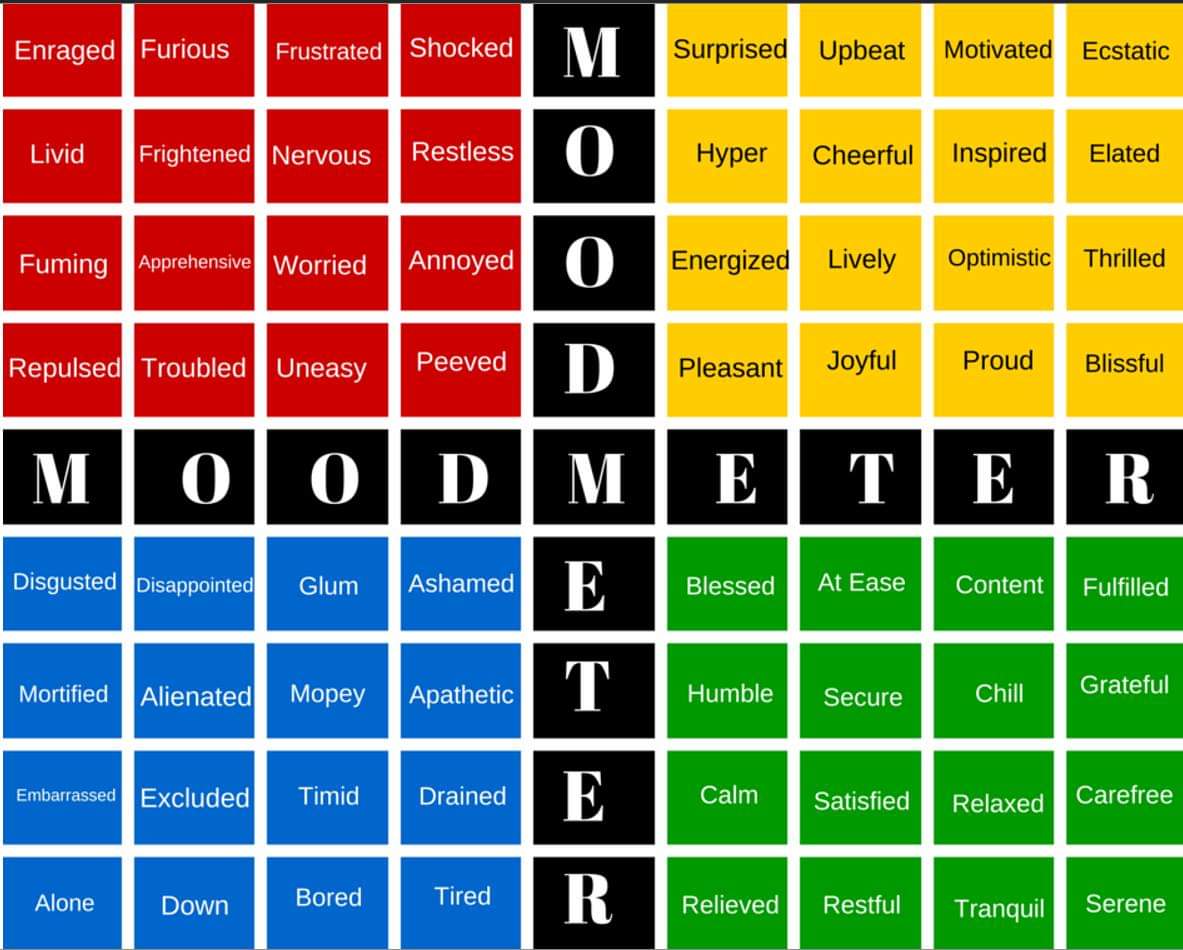
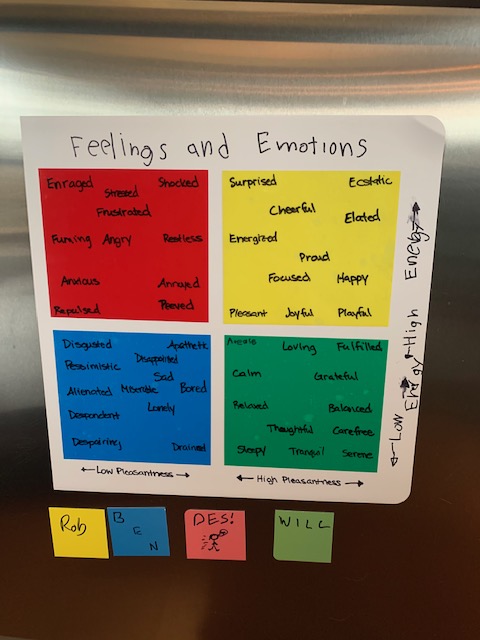
Mood MeterFamily Mood Meter

To make your own Feelings and Emotions/Mood Meter (and maybe a few for others):

What you will need:

– White Magnetic Board

– Transparent Adhesive Film – Multicolor pack

  • Yellow & Red
  • Blue & Green

– Black Sharpie Marker

Make your own individual magnets for each person in your family. Put all the words from the Mood Meter on your board, or choose the ones that fit for your family and for where your kids are in their development and vocabulary. Be creative and make this chart your own!

Additional resources to discuss and manage emotions with your family:

My Moods, My Choices Flipbook

Feelings and Dealings: An Emotions and Empathy Card Game

Feelings in a Flash Cards – Empathy Activities, Coping and Social Skills

The ABCs of Emotions

Emotional Bingo for Children (In English and Spanish!)

Grumpy Monkey by Suzanne Lang

The Very Cranky Bear by Nick Bland

When Sophie Gets Angry – Really, Really Angry by Molly Bang

The Golden Rule by Ilene Cooper

The Rabbit Listened by Cori Doerrfeld

Be Kind by Pat Zietlow Miller

Stand Tall Molly Lou Melon by Patty Lovell and David Catrow

For additional thoughts and information, stay tuned for my posts on Repair Conversations, Redefining and Rebalancing, and Hope and Resilience!

  • Three Thoughts for Thursday
  • Uncategorized

Spring has Sprung and WOW is it Messy!

Desiree Briel Rodi Consulting & Coaching's avatar Desiree Briel Rodi Consulting & Coaching March 19, 2020

Three Thoughts for Thursday – March 2020!

I began to write this a few weeks ago, before the virus turned our world upside down.  A few days ago, I sat down to review what I’d written, thinking I would need to scrap it and focus on something more related to where we all sit today.  As I read what I’d written, I found my thoughts even more poignant now as spring officially begins and we sit in the mud and mess together.  I hope this reflection gives you hope and slowly we all begin to germinate.
~
cherry blossoms

Ahhhh, spring has sprung!  Here in Seattle, the cherry trees are in full bloom and it is magical!  My boys had pestered me for months to make sure we got a spot in the local pea patch garden down the street.  Thankfully, I had remembered to call and put our name on the list early New Year’s Day.  Still, we were number 14 on that list.  Boy did I thank my lucky stars when I got the call – we got a spot!  My boys were THRILLED!

I have been thinking about the darkness of winter from which spring comes in all its colorful glory, and about the mud that nurtures and grows the seeds we plant. When we moved to LA, my boys were so taken by the sunshine and the possibility for a garden.  I watched as they dumped whole packets of seeds into each hole they dug.  I smiled as I saw their delighted faces when one plant grew.  They planted those seeds with reckless abandon and hope, and were so satisfied when even one seedling daringly sprang forth.

As we get older, we seem to fear getting dirty, and we get so stingy with our seeds, but why? We feel the need to follow the directions on the seed packet, or we buy seedlings too afraid of getting nothing from our seeds, or too impatient to wait for the sprouting process to occur. We become so regimented and tidy, and even when one plant sprouts, we wonder why only one rather than celebrating that one that courageously sprung from the ground. Taking this metaphor further into our relationships, families and work, I also see how children don’t fear getting messy.  They fight one minute and are playing together again the next without concern for how violently they just fought; the laughter soon follows the rage and tears.

When do we lose this resilience and faith and become rigid and fearful of the mess of living? When do we begin to calculate the efforts we put forth in a relationship and demand we get equal or more in return?  When do we become slow to forgive and move forward? When do we begin to forget to celebrate the one triumph as if it were everything, the way we once celebrated the sprouting of one seed in the hundred or so we dumped into the garden? When do we become afraid to get our hands dirty?  When do we forget the beauty that can spring from the mud?

As spring approaches, I encourage you to plant and celebrate with reckless abandon.  I encourage you to invest in relationships and to bloom and put forth your beauty without calculation. I implore you to manifest the best in yourself without expectation simply because you have beauty within worth sharing.  Show off your colors, stand tall and shine!  Nurture the seeds and sprouts around you and notice and appreciate their beauty. Bask in the sunshine and the rain and put forth your best!

adding dirt
planting
Quote I am sitting with, pondering and finding inspirational:
Sticking with uncertainty is how we learn to relax in the midst of chaos, how we learn to be cool when the ground beneath us suddenly disappears. We can bring ourselves back to the spiritual path countless times every day simply by exercising our willingness to rest in the uncertainty of the present moment—over and over again.

Pema Chodron

Podcast/Lecture Series I’m Listening To:

The Power of Vulnerability: Teachings of Authenticity, Connection and Courage
lecture series by Brené Brown

 Show Up and Let Yourself be Seen
Is vulnerability the same as weakness? “In our culture,” teaches Dr. Brené Brown, “we associate vulnerability with emotions we want to avoid such as fear, shame, and uncertainty. Yet we too often lose sight of the fact that vulnerability is also the birthplace of joy, belonging, creativity, authenticity, and love.” On The Power of Vulnerability, Dr. Brown offers an invitation and a promise – that when we dare to drop the armor that protects us from feeling vulnerable, we open ourselves to the experiences that bring purpose and meaning to our lives. Here she dispels the cultural myth that vulnerability is weakness and reveals that it is, in truth, our most accurate measure of courage.

“The Power of Vulnerability is a very personal project for me,” Brené explains. “This is the first place that all of my work comes together. This audio course draws from all three of my books – it’s the culmination of everything I’ve learned over the past twelve years. I’m very excited to weave it all into a truly comprehensive form that shows what these findings and insights can mean in our lives.”

Guidance and Insights for Wholehearted Living
Over the past twelve years, Dr. Brené Brown has interviewed hundreds of people as part of an ongoing study of vulnerability. “The research shows that we try to ward disappointment with a shield of cynicism, disarm shame by numbing ourselves against joy, and circumvent grief by shutting off our willingness to love,” explains Dr. Brown. When we become aware of these patterns, she teaches, we begin to become conscious of how much we sacrifice in the name of self-defense -and how much richer our lives become when we open ourselves to vulnerability.

“In my research,” Dr. Brown says, “the word I use to describe people who can live from a place of vulnerability is wholehearted.” Being wholehearted is a practice-one that we can choose to cultivate through empathy, gratitude, and awareness of our vulnerability armor. Join this engaging and heartfelt teacher on The Power of Vulnerability as she offers profound insights on leaning into the full spectrum of emotions-so we can show up, let ourselves be seen, and truly be all in.

HIGHLIGHTS

  • Cultivating shame resilience-the key to developing a sense of worth and belonging.
  • Vulnerability as the origin point for innovation, adaptability, accountability, and visionary leadership.
  • Our emotional armory – how we use perfectionism, numbing, and other tactics to avoid feeling vulnerable.
  • The myths of vulnerability – common misconceptions about weakness, trust, and self-sufficiency.
  • Discovering your vulnerability armor – recognizing what makes us shut down, and how we can change.
  • The 10 guideposts of wholehearted living – essential skills for becoming fully engaged in life.
  • Six hours of stories, warm humor, and transformative insights for living a life of courage, authenticity, and compassion from Dr. Brené Brown.
Book I listened to/read that I am now returning to again:
Radical Acceptance by Tara Brach

“Believing that something is wrong with us is a deep and tenacious suffering,” says Tara Brach at the start of this illuminating book. This suffering emerges in crippling self-judgments and conflicts in our relationships, in addictions and perfectionism, in loneliness and overwork – all the forces that keep our lives constricted and unfulfilled. Radical Acceptance offers a path to freedom, including the day-to-day practical guidance developed over Dr. Brach’s 20 years of work with therapy clients and Buddhist students.Writing with great warmth and clarity, Tara Brach brings her teachings alive through personal stories and case histories, fresh interpretations of Buddhist tales, and guided meditations. Step by step, she leads us to trust our innate goodness, showing how we can develop the balance of clear-sightedness and compassion that is the essence of Radical Acceptance. Radical Acceptance does not mean self-indulgence or passivity. Instead it empowers genuine change: healing fear and shame and helping to build loving, authentic relationships. When we stop being at war with ourselves, we are free to live fully every precious moment of our lives.

Wagon
  • Three Thoughts for Thursday
  • Uncategorized

Three Thoughts for Thursday – February 2020

Desiree Briel Rodi Consulting & Coaching's avatar Desiree Briel Rodi Consulting & Coaching February 20, 2020

Three Thoughts for Thursday

Photo by Will O on Unsplash
Photo by Carolyn V on Unsplash
Photo by Tim Marshall on Unsplash

Well, we survived the January doldrums!  February has given us Valentine’s Day, Presidents’ Day and Mid-Winter Break, and spring is now just next door!  But rather than run ahead, I am choosing to honor the winter season and lessons of January, and to spend a little more time looking within and honoring this season of hibernation, dormancy and regeneration. I have been focusing on this idea of love and considering my own journey to love myself.  I have been pondering love as the foundation and nourishment needed to support the bloom, the reaching and fulfillment of our full and glorious potential. So, here are a few resources and thoughts, questions, quotes and moments of inspiration and love to support you on your journey of release and self-acceptance, love and fulfilling your purpose, wherever you are on that journey.

What does love mean to you? How do you receive love? How do you show love?  What makes you feel loved?  What do you love most about yourself? What gets in your way of giving or receiving love? How can you cultivate your capacity to love and be loved?

Quote or Passage I’m Pondering and Appreciating:

Love

 We cultivate love when we allow our most vulnerable and powerful selves to be deeply seen and known, and when we honor the spiritual connection that grows from that offering with trust, respect, kindness, and affection. Love is not something we give or get; it is something that we nurture and grow, a connection that can only be cultivated between two people when it exists within each one of them – we can only love others as much as we love ourselves. Shame, blame, disrespect, betrayal, and the withholding of affection damage the roots from which love grows. Love can only survive these injuries if they are acknowledged, healed and rare.

~ Brené Brown

 The Foundation of Love

 If we do not know how to take care of ourselves and to love ourselves, we cannot take care of the people we love.  Loving oneself is the foundation for loving another person.

~ Thich Nhat Hahn

Photo by Tyler Nix on Unsplash
Photo by Laura Ockel on Unsplash
Photo by Element5 Digital on Unsplash

Podcast I’m Listening To: 

The Tim Ferris Show, Episode #409:  Brené Brown – Striving versus Self-Acceptance, Saving Marriages and More…

“We chase extraordinary moments instead of being grateful for ordinary moments until hard shit happens. And then in the face of really hard stuff – illness, death, loss – the only thing we’re begging for is a normal moment.”   ~ Brené Brown

Dr. Brené Brown is a research professor at the University of Houston where she holds the Huffington Foundation – Brené Brown Endowed Chair at The Graduate College of Social Work. Brené is also a visiting professor in management at The University of Texas at Austin McCombs School of Business.

She has spent the past two decades studying courage, vulnerability, shame and empathy, and is the author of five #1 New York Times bestsellers: The Gives of Imperfection, Daring Greatly, Rising Strong, Braving the Wilderness, and her latest book, Dare to Lead, which is the culmination of a seven-year study on courage and leadership. Brené hosts the Unlocking Us podcast, and her TED talk – The Power of Vulnerability – is one of the top five most viewed TED talks in the world with over 45 million views.

Book I’m Reading:

The Mastery of Self: A Toltec Guide to Personal Freedom by don Miguel Ruiz Jr.

The ancient Toltecs believed that life, as we perceive it, is a dream. We each live in our own personal dream, and all of our dreams come together to form the Dream of the Planet, or world in which we live.

Most of us strive to live happy and peaceful lives, but the Dream of the Planet is full of mental and emotional traps that can knock us off balance and keep us bound in a prison of suffering.

In The Mastery of Self, don Miguel Ruiz Jr. teaches that most of our suffering occurs when we forget that we are the architects of our own reality, and we have the power to change our Dream if we choose. The Mastery of Self takes the Toltec philosophy of the Dream of the Planet and the personal dream and explains how a person can:

  • Wake up
  • Liberate themselves from illusory beliefs and stories
  • Live with authenticity

Once released, we can live as our true, authentic, loving selves, not only in solitude and meditation, but in any place—at the grocery store, stuck in traffic, etc.—and in any situation or scenario that confronts us.

Don Miguel Ruiz Jr. is a Nagual, a Toltec Master of Transformation, a direct descendent of the Toltecs of the Eagle Knight lineage, and the son of don Miguel Ruiz (author of The Four Agreements, a must read!)

mayur-gala-2PODhmrvLik-unsplash


Posts pagination

Previous 1 … 19 20 21 … 24 Next
Blog at WordPress.com.
Desiree Briel Rodi Consulting & Coaching
Blog at WordPress.com.
  • Subscribe Subscribed
    Desiree Briel Rodi Consulting & Coaching
    Join 36 other subscribers

    Have a WordPress.com account? Log in now.

  • Desiree Briel Rodi Consulting & Coaching
    View site in Reader
    Manage subscriptionsSign upLog in
    Report this content
    Collapse this bar
Loading Comments...